
Virtual Reverb in Ambisonics
Adding reverberation to an Ambisonic mix requires different strategies than in stereo or multichannel production. The central question is whether the reverb should relate to the spatial position of individual sources, or whether it acts as a global property of the soundfield. The five approaches below address this at different levels of the signal chain, from the HOA master bus down to individual source encoding.
HOA Bus Reverb
The simplest approach is to insert a reverb plugin directly on the HOA master bus, processing all channels simultaneously.
Plugins (all platforms):
IEM FdnReverb — a feedback delay network reverb operating on the full HOA bus, preserving channel count and normalization.
SPARTA MultiReverb — applies reverberation to an Ambisonic bus with control over room size and decay.
The main limitation is spatial incoherence: every source in the mix receives the same reverb tail regardless of its encoded position. A source panned to the front and one panned to the rear share an identical room response, which is physically implausible.
This approach is appropriate only for a global late diffuse tail — the final 1–2 seconds of a long reverb where energy is so scattered that it has no meaningful directional character. Late reverberation in real rooms is genuinely non-directional (Zotter & Frank, 2019), so a uniform wash across the bus is not wrong in that specific context. For early reflections, or any situation where source position matters, one of the methods below is more appropriate.
IEM RoomEncoder
The IEM RoomEncoder takes a mono source and a geometric shoebox room model and outputs a full HOA-encoded signal that includes both the direct sound and spatially correct early reflections.
The room is defined by:
Room dimensions (length, width, height)
Wall absorption coefficients per surface
Source position within the room
Listener position within the room
Reflections are computed via the image source method (Allen & Berkley, 1979): each wall reflection is treated as a virtual copy of the source mirrored across that surface, encoded at its correct angle and delay. The result carries genuine spatial information about the room geometry — place a source close to the left wall and the first reflection arrives from the left; place a source at the rear and the early reflections come from behind.
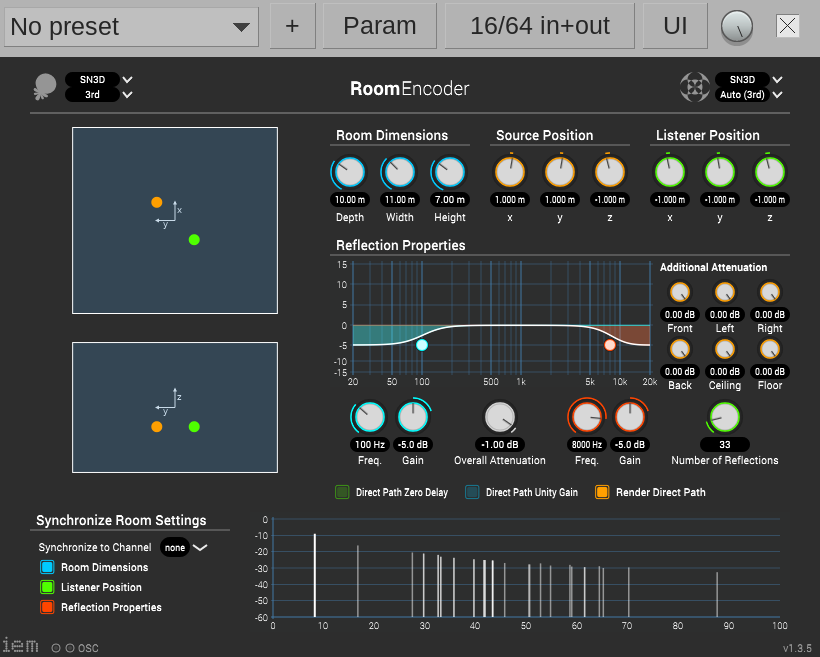
IEM RoomEncoder: direct sound, early reflections, and late tail all encoded into HOA from a single geometric room model.
The spatial relationship between source and room is baked into the HOA signal at the encoding stage, not applied as a post-process. In Reaper, the RoomEncoder replaces the standard IEM MultiEncoder on a source track: source position is set within the virtual room rather than as a simple azimuth/elevation angle.
Plugin: IEM RoomEncoder — Linux, macOS, Windows.
Object-Based Reverb
In the object-based approach, reverb is applied to each source before encoding into Ambisonics. Each source carries its own spatial tail into the soundfield, encoded at the same position as the dry signal — or at a slightly wider spread to simulate room diffusion around the source.
A typical source chain in Reaper:
Dry mono source
Pre-fader send to a reverb plugin
Encode both dry and wet signals via IEM MultiEncoder — the wet signal can use a wider source width to suggest spatial spread
Both feeds sum into the HOA master bus
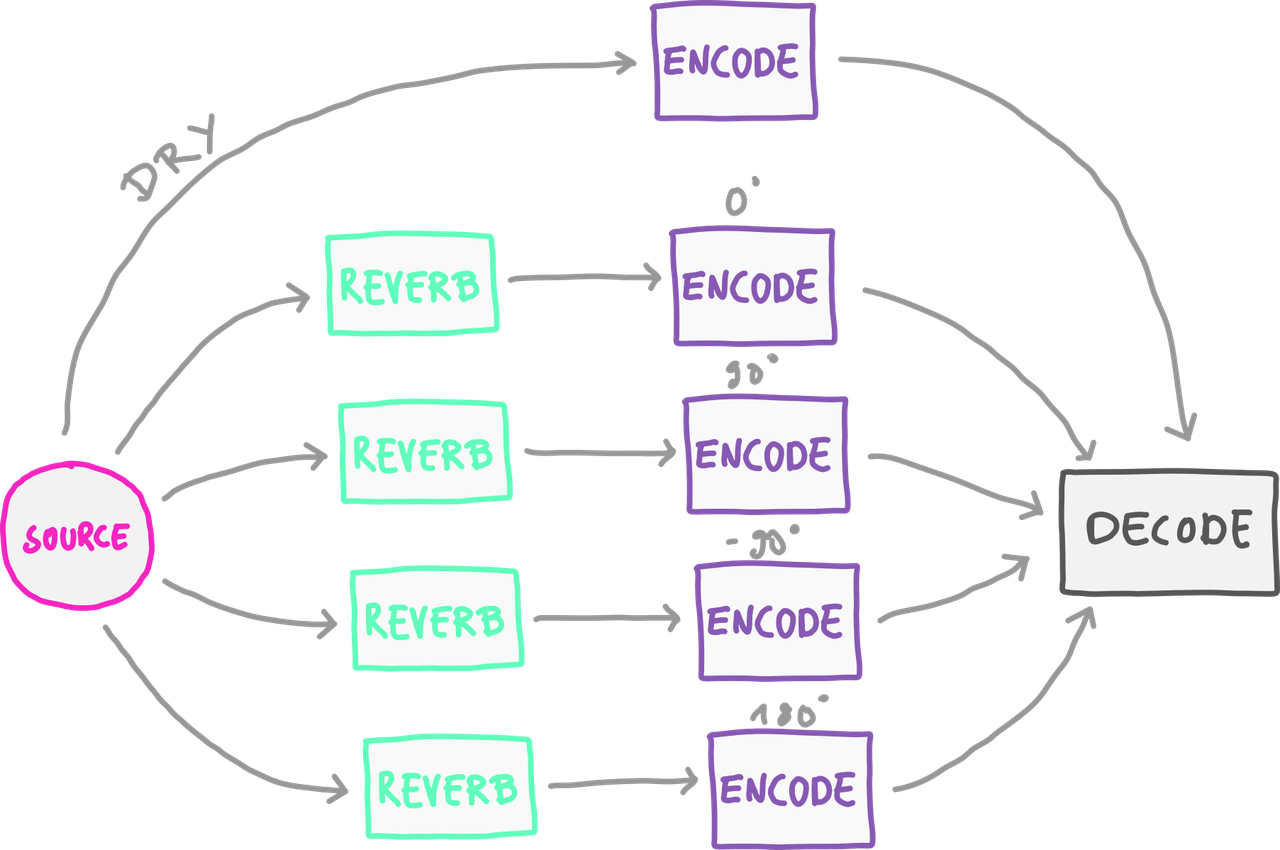
Object-based reverb: each source carries its own spatial tail into the HOA bus via independent encoding.
The main consideration is that the reverb output also needs to be encoded. A stereo reverb return left unencoded will sit outside the Ambisonic soundfield and collapse to the stereo field on decode.
Suitable reverb plugins:
Platform |
Plugin |
Notes |
|---|---|---|
Linux |
Dragonfly Reverb, Mverb (LV2), CAPS Reverb |
Dragonfly also available as VST3 |
macOS |
Dragonfly Reverb, Valhalla Room, FabFilter Pro-R |
|
Windows |
Dragonfly Reverb, Valhalla Room, FabFilter Pro-R |
For dense textures with many sources, grouping sources by spatial region and sharing a reverb per group is a practical compromise between control and CPU overhead.
Direct-to-Ambi: Multiple IRs to WXYZ
Rather than using a measured B-format IR or a dedicated Ambisonic reverb plugin, it is possible to construct a synthetic B-format reverb return by routing a source through four separate convolution reverbs — one per channel — and assigning each output to \(W\), \(X\), \(Y\), and \(Z\) individually.
The spatial character of the result comes from differences between the four IRs. Using four completely identical IRs produces a coherent omnidirectional tail equivalent to a mono reverb on \(W\) only. Using four similar but not identical IRs — for example, four IRs from the same space recorded at slightly different positions, or the same IR with small decorrelating differences applied — introduces controlled variation between the channels that the decoder interprets as spatial diffuseness.
A practical workflow:
Take a mono source or a pre-mix send
Route it to four parallel convolution reverb instances
Load a similar but distinct IR in each instance (same space, different microphone positions, or the same IR with a short allpass or slight pitch variation applied to decorrelate)
Route the four outputs to channels 1–4 of an Ambisonic bus in ACN order: \(W\) (ch 1), \(Y\) (ch 2), \(Z\) (ch 3), \(X\) (ch 4)
Feed this FOA bus into the HOA master as a reverb return
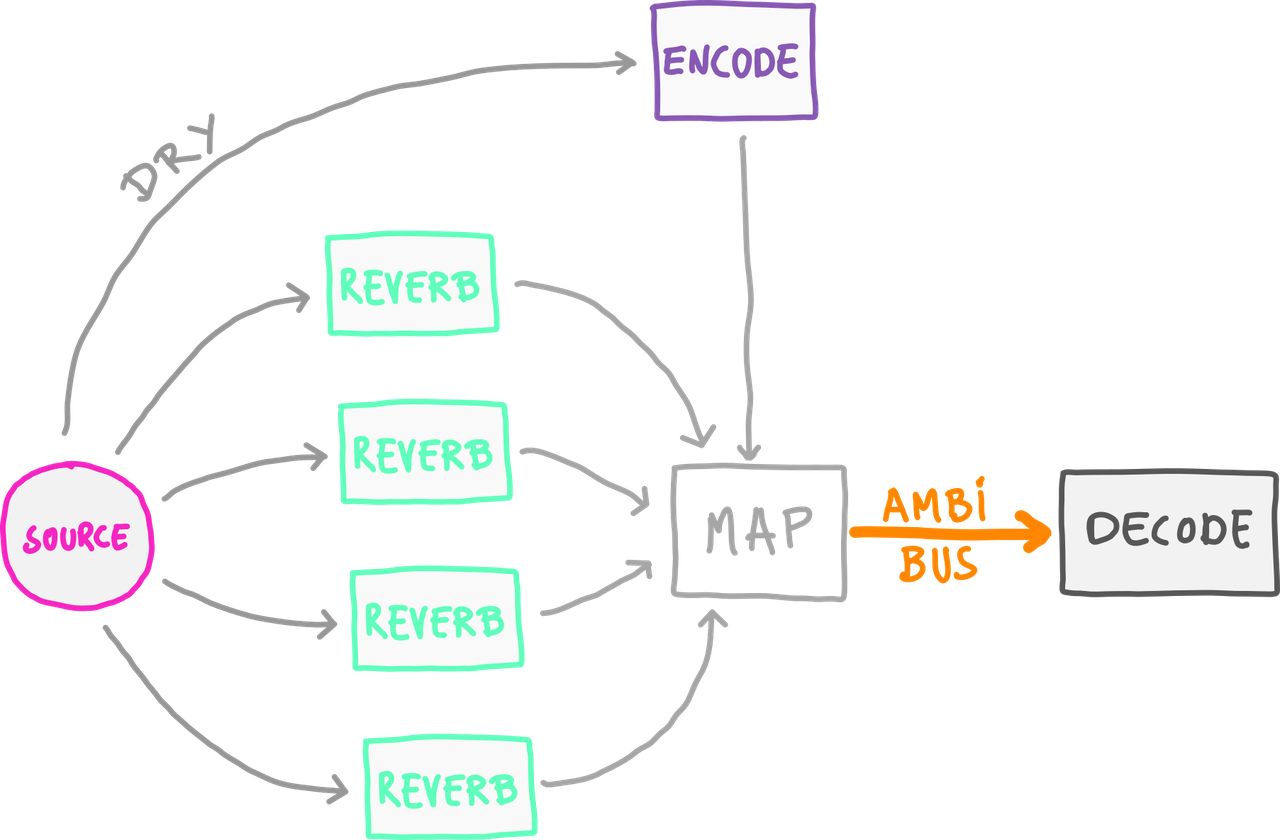
Four decorrelated IRs routed to WXYZ — synthetic B-format reverb return assembled from independent convolution instances.
The degree of spatial diffuseness is shaped by the degree of difference between the four IRs: larger differences produce a wider, more enveloping tail; smaller differences produce a more coherent, centered response.
W-channel gain (SN3D normalization)
In SN3D normalization, \(W\) is scaled by \(1/\sqrt{2}\) relative to the directional channels. Apply this gain offset (approximately −3 dB) to the \(W\) convolution instance before it enters the Ambisonic bus. Without this correction the omnidirectional component will be overrepresented and the mix will feel heavy and pressurised rather than spatially diffuse.
Convolution plugin:
ReaVerb (included with Reaper) loads WAV files directly via a standard file dialog and works identically on Linux, macOS, and Windows. No additional installation required.
Direct-to-Ambi: B-Format Convolution Reverb
A B-format impulse response captures a real or simulated acoustic space as four simultaneously recorded signals corresponding to the \(W\), \(X\), \(Y\), and \(Z\) components of a first-order Ambisonic microphone array. Convolving a mono source against these four IRs produces a first-order encoded reverb tail that carries the measured directional character of the space — late energy arriving from the sides, early reflections from specific wall angles — encoded directly into the B-format channels.
The key distinction from the multi-IR approach above is that the four IRs are co-recorded: the spatial relationships between channels are physically correct, not synthetically constructed.
In practice:
Obtain a B-format IR (sources listed below)
Route the source to four convolution reverb instances, one per channel, loaded with the corresponding IR component in ACN order: \(W\) (ch 1), \(Y\) (ch 2), \(Z\) (ch 3), \(X\) (ch 4)
Apply the \(W\) channel gain correction: −3 dB (SN3D, \(1/\sqrt{2}\))
Route the four outputs to a FOA bus and feed it into the HOA master
B-format IR sources:
OpenAIR — free library of measured acoustic spaces, several including B-format IRs
EigenScape — B-format IRs of outdoor and urban environments (Zenodo, CC-BY)
TALib — Théâtre Acoustique Room Impulse Response Library — stereo IRs from a joint IRCAM/ZKM artistic residency, recorded in a range of spaces; free for artistic and research use (CC-BY-NC 4.0). Suitable for the multi-IR approach below.
The IEM RoomEncoder can export synthetic IRs for a shoebox room, usable in any convolution plugin
Convolution plugin: ReaVerb (included with Reaper) — same as above.
Comparison
HOA Bus Reverb |
RoomEncoder |
Object-Based |
Multi-IR WXYZ |
B-Format Conv. |
|
|---|---|---|---|---|---|
Source position awareness |
None |
Full (geometric) |
Per source |
None |
Partial (FOA) |
Early reflections |
No |
Yes |
Depends on plugin |
Depends on IRs |
Yes (measured) |
Late diffuse tail |
Yes |
Simplified |
Yes |
Yes |
Yes |
HOA order preserved |
Yes |
Yes |
Yes |
FOA only |
FOA only |
Per-source overhead |
None |
Low |
High |
Low–Medium |
Low–Medium |
Suitable for |
Global tail only |
Positioned sources |
Dense object mixes |
Synthetic spaces |
Measured spaces |
References
2019
- Franz Zotter and Matthias Frank.
Ambisonics: A Practical 3D Audio Theory for Recording, Studio Production, Sound Reinforcement, and Virtual Reality.
Springer, 2019.
doi:10.1007/978-3-030-17207-7.
[details] [BibTeX▼]
1997
- Jens Blauert.
Spatial Hearing: The Psychophysics of Human Sound Localization.
MIT Press, revised edition, 1997.
[details] [BibTeX▼]
1979
- Jont B. Allen and David A. Berkley.
Image method for efficiently simulating small-room acoustics.
Journal of the Acoustical Society of America, 65(4):943–950, 1979.
doi:10.1121/1.382599.
[details] [BibTeX▼]